
Prompt engineering is not guessing
Here’s how most people use LLMs: type something, read the response, decide it’s not quite right, rephrase, try again, get something acceptable, move on, forget what worked.
Tomorrow they start from zero.
This is prompt engineering by trial and error. It works, technically. But it’s slow, inconsistent, and you never build on what you’ve learned.
The disposable prompt problem
Most prompts are written once and thrown away. They live in a chat window, maybe get copy-pasted into a doc somewhere, and eventually get lost.
This means you solve the same problem repeatedly. Found the perfect tone for customer emails last week? Good luck remembering exactly how you phrased it. Quality becomes inconsistent too: Monday’s prompt produces great output, Tuesday’s slightly different version falls flat, and you’re not sure why. And none of that knowledge transfers. Your teammate figured out how to get the model to write concise technical docs, but that knowledge lives in their head or buried in their chat history.
These are the exact problems that version control, reusable components, and documentation already solve in software engineering. Prompts deserve the same treatment.
Prompts are artifacts, not conversations
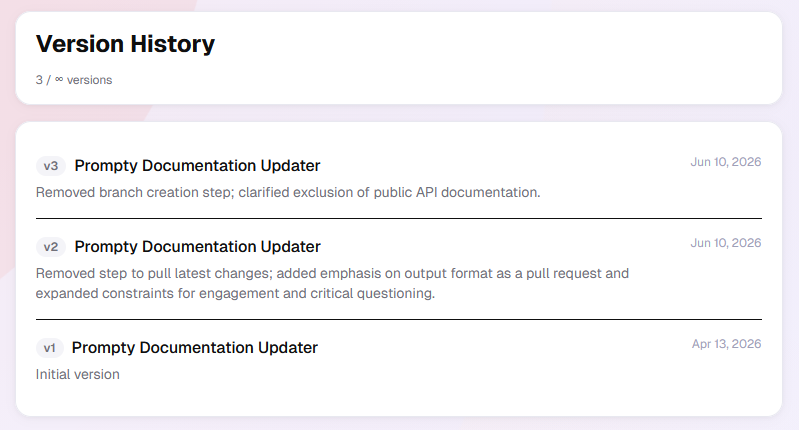
Here’s the mindset shift: a prompt isn’t just a message you type into a chat box. It’s a specification. It describes the output you want with enough precision that the result is predictable and repeatable.
Good specifications share a few properties:
- They’re versioned. When you improve a prompt, you keep the old version so you can compare.
- They’re modular. The persona definition is separate from the task, which is separate from the constraints. You can mix and match.
- They’re reusable. A well-written prompt for “friendly B2B email copy” works for onboarding emails, feature announcements, and renewal reminders.
- They’re shareable. Someone else can use your prompt and get comparable results.
When you treat prompts as things you deliberately craft, store, and improve, everything changes.
What this looks like in practice
Say you’re a content marketer who regularly writes LinkedIn posts for your company.
The guessing approach: Every time you need a post, you open ChatGPT and wing it. Sometimes you remember to specify the tone. Sometimes you forget the character limit. The results vary wildly.
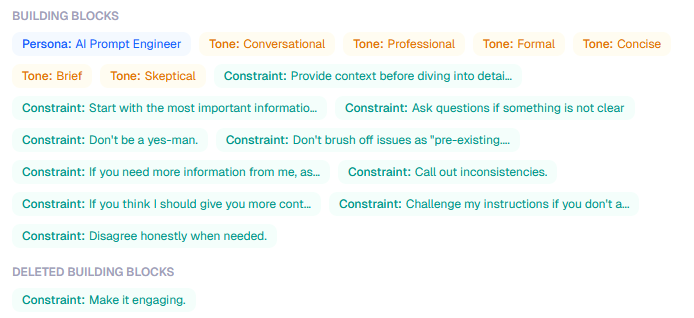
The structured approach: You build a set of components once:
Now every LinkedIn post starts from the same foundation. You only change the topic and the specific context. The quality floor goes way up, and the time per post drops.
It compounds
This approach gets better with time. Every prompt you write well becomes a tool you can use again. Every persona you define works across dozens of tasks. Every set of constraints you dial in saves you from the same mistakes next time.
After a few weeks, you’re not writing prompts from scratch anymore. You’re assembling them from proven parts.
After a few months, you have a library that represents everything you’ve learned about communicating with language models. It encodes your judgment, preferences, and domain expertise in a way that’s immediately actionable.
Why we built Prompty this way
This is the core idea behind Prompty.tools. We don’t think of it as a “prompt writing tool.” It’s a system for building, organizing, and reusing the components that make prompts work.
You create personas, define tones, set constraints, and specify output formats, each as a standalone, reusable building block. When you need a prompt, you combine the relevant pieces. When you find something that works, it’s saved and available for next time.
It’s the difference between a pile of random notes and a well-organized toolkit.
Getting started
You don’t need a tool to adopt this mindset (though it helps). Start with this:
- Next time you get a great result from a prompt, save it. Not in a chat log. In a document you’ll actually find again.
- Identify the reusable parts. Which pieces are specific to this task, and which would work for similar tasks?
- Separate the components. Pull out the persona, tone, and constraints into their own sections.
- Reuse them next time. Start your next prompt by pulling in the components that worked before.
Prompt engineering isn’t about finding the perfect words through trial and error. It’s about building a system that makes quality repeatable.