
5 prompts that actually work for content writing
Enough theory. Here are five prompts you can copy, paste, and use right now for common content writing tasks.
Each one uses the building block structure (persona, task, tone, constraints, and output format) but you don’t need to think about that. Just use them. Tweak what doesn’t fit your situation.
1. The blog post outline
You know the topic, but staring at a blank page isn’t going anywhere.
Why it works: The persona gives you the perspective of someone who does this professionally. The constraints around heading style and word count prevent the model from producing a generic skeleton. The output format means you get something you can actually hand to a writer (or yourself).
Swap in: Your industry, your audience, your word count target.
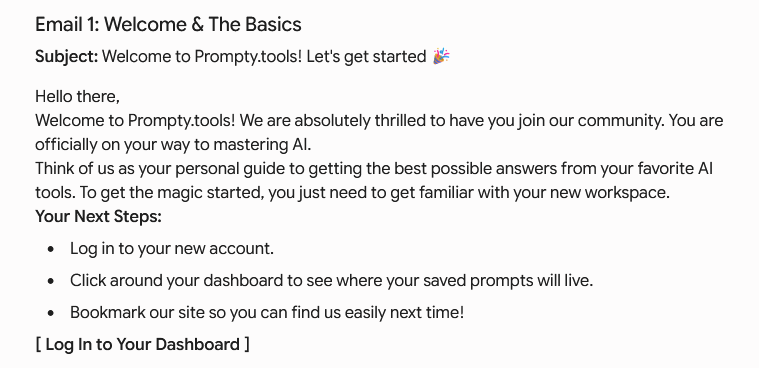
2. The email sequence
Onboarding, nurture, re-engagement. Email sequences are tedious to write from scratch.
Why it works: The paragraph constraint forces conciseness. The email draft output format gives you something ready to paste into your email tool.
Swap in: Your product name, the key action you want users to take, your brand voice.
3. The social media post
Specifically LinkedIn, because that’s where B2B conversations happen and where tone is hardest to get right.
Why it works: The constraints eliminate the most common LinkedIn clichés. Starting with the insight instead of backstory respects the reader’s time and stops the scroll. The character limit keeps it from becoming an essay.
Swap in: Your industry, your specific insight or experience.
4. The product description
For landing pages, feature announcements, or app store listings.
Why it works: The “problem, solution, outcome” structure is a proven copywriting framework. Banning superlatives and jargon forces the model to communicate value through clarity instead of hype.
Swap in: Your feature, your customer’s specific pain point.
5. The technical explainer
For documentation, help articles, or internal knowledge sharing.
Why it works: The structure guarantees completeness. You’ll always get the what, why, how, and example. The constraint against “simply put” prevents the model from being condescending. The audience specification calibrates the depth.
Swap in: The concept, the audience (new developers, product managers, customers, etc.).
Make them your own
These prompts are starting points. The real power comes from adapting them to your voice, your audience, and your specific needs. Change the persona to match your domain. Adjust the constraints based on what annoys you most about AI-generated content. Swap the output format to match your workflow.
If you find yourself tweaking the same elements over and over (the same persona, the same tone, the same constraints) that’s a sign you should save those as reusable building blocks. That’s exactly what Prompty.tools lets you do: build once, use everywhere.
Copy one of these prompts, try it right now, and see what happens. Then make it better.