
The anatomy of a good prompt
There’s a reason some prompts get incredible results while others produce forgettable output. It’s not luck, and it’s not about finding magic phrases. Good prompts have structure.
Once you see the structure, you can’t unsee it. Let’s break it down.
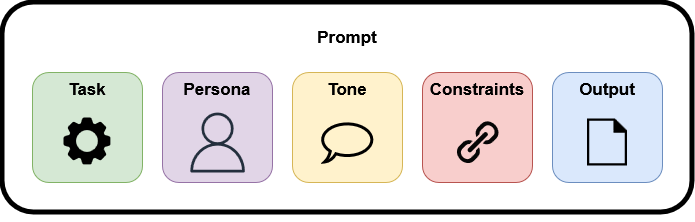
The five building blocks
Every effective prompt is made up of some combination of these five elements. You won’t always need all of them, but knowing what they are lets you deliberately choose which ones matter for your situation.
1. The persona
This is who the model should be. It sets the expertise level, perspective, and communication style for everything that follows.
Without a persona:
Explain API rate limiting.
With a persona:
You are a senior backend engineer explaining a concept to a product manager who’s technically curious but doesn’t write code. Explain API rate limiting.
The second version doesn’t just change the words. It changes the depth, the analogies used, and what gets emphasized. The model adapts its entire approach based on who you tell it to be.
2. The task
This is the what. It sounds obvious, but most weak prompts fail here because a vague task was used.
Vague: “Write something about onboarding.”
Clear: “Write a step-by-step onboarding email sequence (3 emails) for new users of a project management tool. Each email should have a subject line, body text, and one clear call-to-action.”
The difference is specificity. A clear task defines:
- The deliverable (what you’ll get back)
- The scope (how much of it)
- The format (how it should look)
3. The tone
Tone is how the output should feel. It’s separate from the persona. A senior engineer can write casually or formally. Tone is the emotional register.
Some useful tone descriptors:
- Casual and encouraging
- Professional and concise
- Empathetic and supportive
- Direct and no-nonsense
- Playful but informative
Pro tip: Combining two tone words works better than one. “Friendly” is vague. “Friendly but direct” gives the model a much clearer target.
4. The constraints
Constraints are the guardrails. They tell the model what to avoid, and they’re often more important than what you tell it to do.
Good constraints:
- “Don’t use jargon, the audience is non-technical”
- “Keep it under 200 words”
- “Don’t include disclaimers or hedge language”
- “Never mention competitor products by name”
- “Use only examples from the healthcare industry”
Think of constraints as bumper lanes at a bowling alley. They don’t tell the ball where to go. They keep it from going where it shouldn’t.
5. The output format
This is the shape of the response. It’s the most underrated building block because it’s the easiest to specify and has the highest impact.
Examples:
- “Return the result as a markdown table with columns: Feature, Benefit, Example”
- “Format as a numbered list with one sentence per item”
- “Write as a JSON object with keys: title, summary, tags”
- “Structure as: Hook (1 sentence), Problem (2 sentences), Solution (3 sentences), CTA (1 sentence)”
When you define the output format, you eliminate an entire category of “that’s not what I wanted” responses.
Putting it all together
Here’s what a complete prompt looks like when you combine all five blocks:
Persona: You are a conversion copywriter with 8 years of experience in SaaS landing pages.
Task: Write a hero section for a prompt engineering tool. Include a headline, subheadline, and CTA button text.
Tone: Confident and clear. No hype or buzzwords.
Constraints: Keep the headline under 10 words. Don’t use the words “revolutionary” or “game-changing.” Don’t mention AI explicitly, focus on the outcome.
Output format: Return as three clearly labeled sections: Headline, Subheadline (1-2 sentences), CTA.
That’s a prompt that will produce something usable on the first try. Not because it’s long, but because it’s precise.
You don’t always need all five
A quick question to a model might only need a persona and a task. A creative brainstorm might skip constraints entirely. The point isn’t to fill out a template every time. It’s to know which levers exist so you can pull the right ones.
Some examples:
| Situation | Essential blocks |
|---|---|
| Quick question | Task |
| Content creation | Persona + Task + Tone + Output format |
| Technical explanation | Persona + Task + Constraints |
| Data formatting | Task + Output format + Constraints |
| Creative ideation | Persona + Task + Tone |
Building blocks, not boilerplate
The reason we think about prompts as building blocks (not templates) is that they’re composable. A persona you wrote for customer support emails works just as well for writing help docs. A set of brand tone constraints applies to every piece of content you create.
That’s the idea behind Prompty.tools. Instead of writing prompts from scratch, you build a library of reusable components and snap them together for each task. Personas, tones, constraints, output formats, all of them mix and match.
But whether you use a tool or not, the anatomy stays the same. Learn the five blocks, and you’ll write better prompts for the rest of your life.